

In his celebrated novel Love in the Time of Cholera, Gabriel García Márquez portrayed how authentic and enduring love could survive amid the ravages of an epidemic. Cholera, in the novel, was both a literal disease and a metaphor for decay, obsession, and social malaise.
In the Philippines, democracy itself now suffers from a comparable contagion: the pandemic of political dynasties.
Political dynasties have become the cholera of Philippine democracy. They spread not through bacteria but through patronage, dependency, inherited power, and the systematic capture of public institutions. Armed with immense resources mined from the very government they supposedly serve, dynastic clans dominate elections with the efficiency of a political virus that reproduces itself every electoral cycle.
The question therefore arises: can genuine democratic passion still survive in an environment where poverty and vote-buying dictate electoral behavior? Can the electorate remain idealistic when survival itself is transactional?
Political dynasties have conditioned many voters to commercialize their votes. Elections are no longer contests of principles but auctions of loyalty. In many communities, ballots are treated as commodities exchanged for cash, groceries, medicine, scholarships, sacks of rice, or fleeting favors distributed days before election season.
“3 beses natalo yan si Trillanes”
It is within this environment that Jonvic Remulla taunts Antonio Trillanes IV for losing three elections. Such mockery reveals either astonishing political blindness or breathtaking entitlement. Remulla speaks from the comfort of a deeply entrenched dynasty that has transformed Cavite into a near-hereditary political domain.
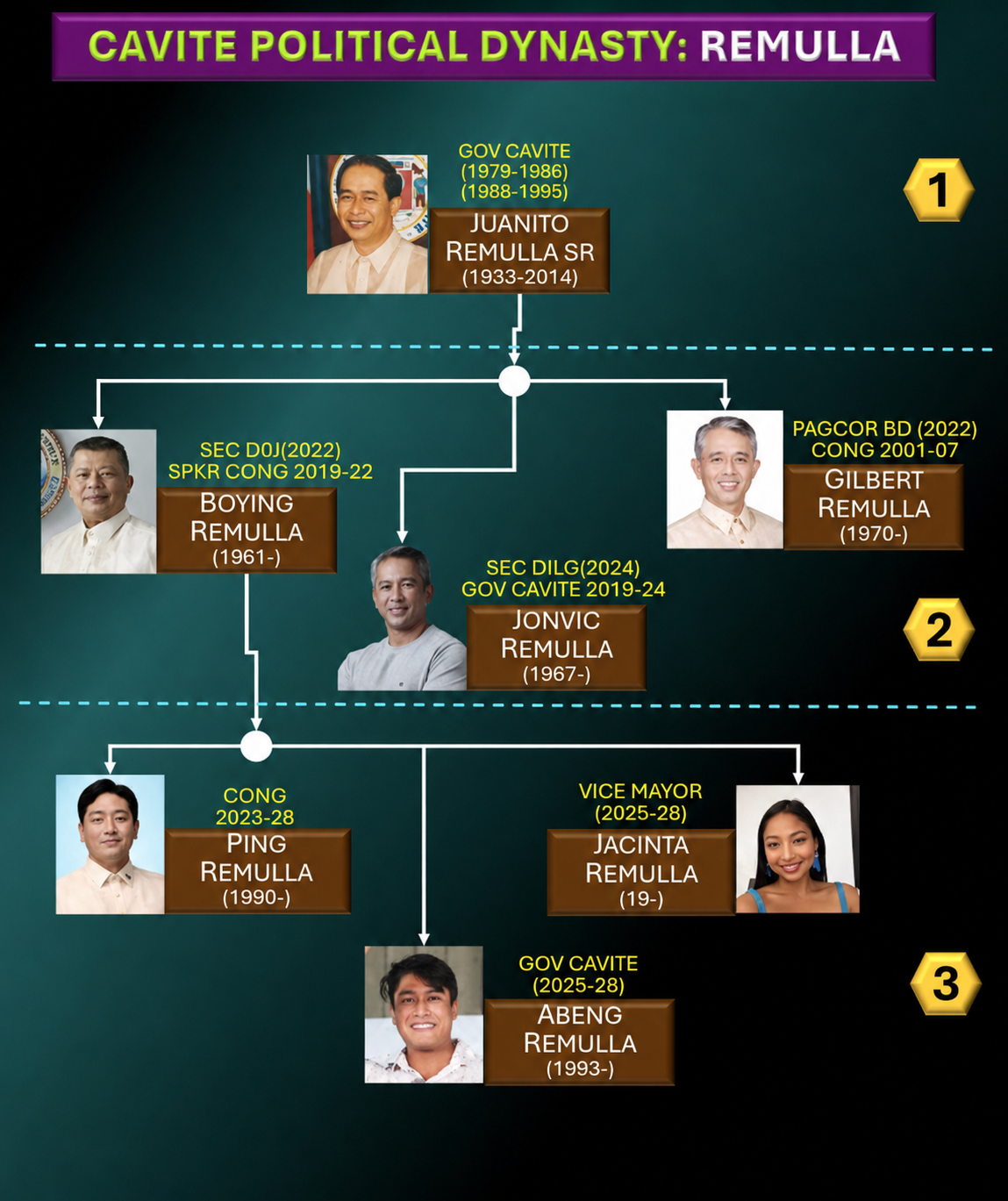
The Remulla network illustrates how dynastic power operates in the Philippines. Various members of the clan simultaneously occupy or have occupied strategic elective and appointive positions:
- Jesus Crispin Remulla served as Justice Secretary and now newly minted Ombudsman, and previously represented Cavite’s 7th District in Congress.
- Jonvic Remulla became Secretary of the Interior and Local Government after serving multiple terms as governor of Cavite.
- Abeng Remulla currently serves as governor.
- Ping Remulla represents Cavite’s 7th District.
- Gilbert Remulla served as congressman for Cavite’s 2nd District.
- Jacinta Remulla occupies a local executive position in Naic, Cavite.
This concentration of power is not accidental. It is the product of decades of accumulated influence, patronage machinery, financial resources, and control over local political networks.
Local autonomy, originally envisioned to empower communities, became in many provinces a mechanism for warlords and dynasties to entrench themselves further. The state devolved power; the dynasties captured it.
What Then of Trillanes?
Unlike the dynastic politicians he confronts, Trillanes has no sprawling political clan, no entrenched machinery, no inherited bailiwick, and no army of local retainers. He is essentially a lone ranger in a political wilderness populated by feudal clans.
He does not possess the luxury of political “Tontos” — loyal gofers, fixers, and operators financed by vast family networks. Such machinery is reserved for monarchical dynasties like the Remullas and similar political houses across the country.
When Trillanes ran for vice president in 2016, he predictably finished at the tail end of the race. But how could an independent reformist realistically compete against candidates backed by colossal political structures such as the Marcoses, the Aquinos, and other entrenched alliances?
Elections in the Philippines are rarely equal contests. They are asymmetrical wars between entrenched machinery and isolated dissenters.
In 2019, he sought reelection to the Senate amid the height of Rodrigo Duterte’s popularity. Having become one of Duterte’s fiercest critics, Trillanes faced the full force of state-backed hostility and coordinated political demolition. He was defeated overwhelmingly, yet he remained defiant and politically unbowed.
Then came 2025, when Trillanes attempted to seek local office in Caloocan City. Again, he encountered the brutal arithmetic of dynastic politics. He faced electorates cultivated for years by entrenched local clans through patronage, dole-outs, and dependency politics.
Voters were metaphorically, and sometimes literally, “fed and clothed” (binahugan at dinamitan ng isang container na Ukay Ukay) by political families whose resources and machinery dwarf those of independent candidates. In such an environment, reformists often enter elections already politically outgunned before the first ballot is cast.
Trillanes therefore resembles a tragic yet stubborn character out of a García Márquez novel: isolated, flawed perhaps, but defiantly resisting a political landscape consumed by decay and hereditary power.
For Jonvic Remulla to dismiss Trillanes merely because of electoral defeats is to misunderstand the very nature of Philippine elections under dynastic rule. Losing against entrenched political empires is not necessarily proof of irrelevance; sometimes it is evidence of how profoundly distorted the democratic playing field has become.
In the Philippines today, the true contest is no longer simply between candidates. It is between citizenship and dependency, between reform and feudalism, between democratic aspiration and hereditary entitlement.
Until political dynasties are dismantled or meaningfully regulated, elections will continue to resemble less a democratic exercise and more a recurring epidemic: one that infects institutions, corrupts civic values, and reduces public office into a family inheritance.
To Jonvic Remulla, your description of Trillanes reveals your incredible Neanderthal gray matter.