

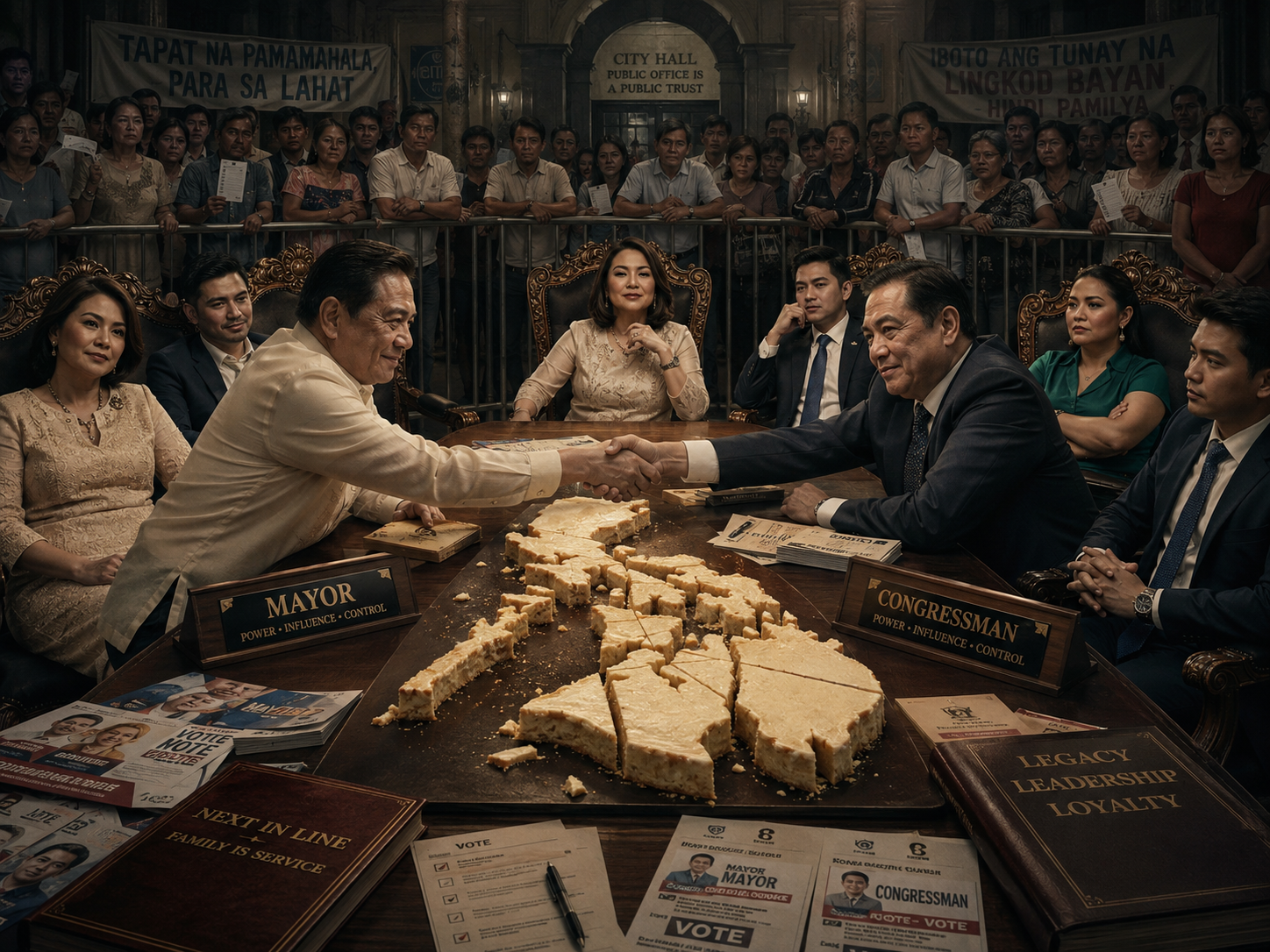
We have reached a chapter in our history where political dynasties—or political tribes—rule the roost in their respective political dominions. In many places, elections have become little more than ceremonial exercises designed to legitimize what has already been decided within political families.
Take, for example, Mandaluyong City in Metro Manila. Two political dynasties have, for years, been engaged in nothing more than a game of musical chairs—or, more aptly, Trip to Jerusalem—rotating the positions of congressman and mayor among themselves, their siblings, and their spouses. Public office has become a family heirloom rather than a public trust.
Sadly, we have reached the saturation point of political tribalism. These political clans rule their territories like monarchs over their kingdoms, where elections are mere formalities. Campaigns no longer consist of persuading the electorate through ideas and platforms. Instead, they revolve around the distribution of largesse and the mobilization of political machinery. They no longer feel compelled to court the voters; rather, they treat them with quiet contempt.
Political debates, once an essential feature of democratic accountability, have virtually disappeared from the vocabulary of these entrenched political tribes. They simply skip them. Those who attend are usually the patakbuhin—the token candidates—or those without resources and political machinery. The frontrunners see no benefit in exposing themselves to public scrutiny.
Viewed in this light, Alan Peter Cayetano’s call for a “ceasefire” with Ping Lacson is telling. It reflects a mindset prevalent among entrenched political dynasties: accountability is secondary to political accommodation. A ceasefire simply means, “Let us stop attacking each other before the public. After all, the people will eventually forget.”
To them, politics is no longer about governance but about preserving power.
The electorate, unfortunately, is often reduced to spectators watching a political circus. The continuing conflict between President Marcos and Vice President Sara Duterte is seen less as a clash of principles than as a struggle over political turf—a contest to determine who will be crowned the next king or queen of Philippine politics, with full control over the machinery of government and, more importantly, the national budget.
The word “ceasefire” has therefore acquired a new political meaning. It has become the language of warring political dynasties negotiating the preservation of their respective kingdoms.
This is not confined to the national stage. In Quezon Province, for example, rival political camps have reportedly discussed a “ceasefire” to arrange among themselves who will occupy which elective posts in the 2028 elections. Multiply this practice across the country’s provinces, congressional districts, cities, municipalities, and even barangays, and one sees a disturbing pattern: political ceasefires are not about national reconciliation but about dividing the political spoils among competing clans.
In the end, the cake is divided among the few while the people are left with the crumbs. Democracy survives in form, but its substance is steadily eroded by political arrangements made behind closed doors, to the detriment of the very citizens in whose name government is supposed to exist.
Mabuti na lang hindi pumayag si Ping. Is this the turning point of political dynasties?