

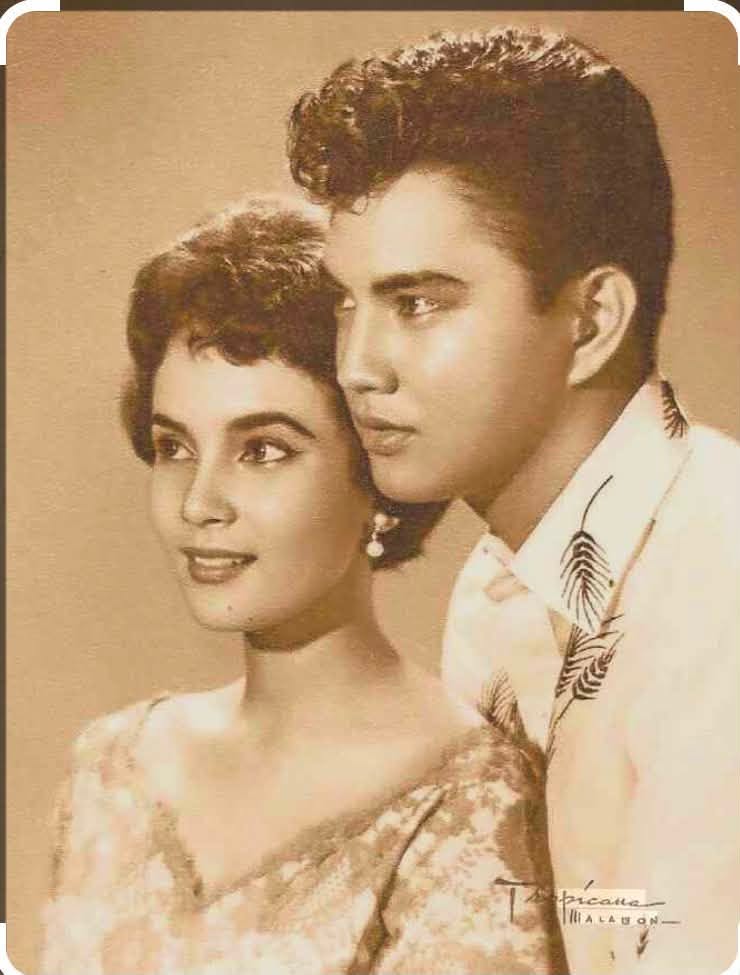
Romeo Vasquez, whose real name was Roberto Alandy Sumilang, was a native son of Tayabas, Quezon. He may rightly be counted among the great Filipino matinee idols of the 1950s and 1960s. He possessed the looks, charm, and screen presence reminiscent of Elvis Presley or Richard Burton that made him one of the most recognizable leading men of his generation.
When his star began to wane, so to speak, Romeo moved to the United States, where he reportedly found a lucrative occupation selling high-end cookware to Filipino families.
Eddie Gutierrez later followed a similar path. When Eddie’s own star power had diminished and producers were no longer lining up to cast him as a leading man, he also moved to the United States with Annabelle Rama, who eventually became his wife. Romeo Vasquez reportedly mentored Eddie in the cookware business.
Their sales technique was ingenious. They would visit the homes of prosperous Filipinos in the United States, usually doctors, lawyers, businessmen, and nurses. Because Romeo and Eddie were famous movie stars from the Philippines, the homeowners would invite their Filipino friends and neighbors to attend the product demonstration.
It was not merely a cookware presentation. Half of the program could be devoted to introducing Eddie Gutierrez as one of the Philippines’ great matinee idols. The guests came as much to see and meet the movie star as they did to examine the pots and pans. Celebrity became their passport into Filipino homes, and nostalgia helped them make the sale.
This was during the late 1960s and 1970s, when bomba films and other sexually provocative pictures were spreading like wildfire in the Philippines. Instead of accepting roles in sexy or softcore films that might have diminished their stature as former matinee idols, Romeo Vasquez and Eddie Gutierrez sought a different livelihood in America. Ironically, a Blue Actress named Joy Sumilang (bruited about as a daughter of Vasquez with another unnamed starlet during his heyday) became a famous pene star opposite George Estregan.
Years later, Romeo returned to the Philippines and ventured into politics. Available biographical accounts state that he returned in 1993 and ran for vice governor of Quezon in the 1998 elections. He did not win. His earlier attempt to establish a political base in Tayabas, where Dondi Silang was a formidable local figure, likewise failed to translate his popularity as an actor into political victory. In the meantime, he squired the petite Vilma Santos who has preference of smothering herself with ice cream as Romeo’s dessert.
Tayabas was still a municipality at the time. It became a component city only in 2007 under Republic Act No. 9398. The cityhood measure was authored and sponsored in Congress by the late Rafael “Raffy” Nantes, who later became governor of Quezon. The Senate’s legislative record identifies Rafael Nantes as the author of the cityhood law.
In the 1998 provincial elections, Romeo Vasquez was recruited to run for vice governor in tandem with Agnes Devanadera. I was also a candidate for vice governor, running with Willie Enverga of Lucena and Mauban.
As you know, you (Rommel Arguelles) used to tease me about Willie complaining that I was campaigning heavily in the First and Second Districts. The principal reason was that I was being junked by Enverga in the first and second Districts in favor of the late Jovy Talabong. I had been courted as Willie’s running mate was our political strength and voting base in the Fourth District.
In the end, however, all of us lost the vice-gubernatorial contest to Jovy Talabong. Willie Enverga won as governor, while JovyTalabong became vice governor. Beneath the formal political alignments, Willie and Jovy appeared to be silent partners in the election. In the First and Second Districts, it was Jovy whom Willie effectively carried.
Jovy Talabong had earlier served as legal counsel to Willie’s father, Manuel Enverga, in the inheritance cases filed against the patriarch by his legitimate heirs including Willie. The old man had lost to Moises Escueta and felt betrayed at the time. The dispute was eventually settled, and Manuel Enverga’s children with his secretary also received unsaleable portions of his estate. Nevertheless, the old man was said to have died brokenhearted. At that time the Enverga Family was the butt of gossip thereabouts when the old man maintained his mistress just a stone’s throw away from the White House, the original House ofbthe original family with the Lopez matriarch.
Romeo Vasquez, for his part, stormed the entire province during the campaign. His public appearances were spectacular. Throngs of admirers, many of whom had grown up watching him on the silver screen and were already senior citizens, attended his meetings de avance. Their enthusiastic presence delighted Agnes Devanadera and created the impression that Romeo’s fame might carry their ticket to victory.
But applause is not always convertible into votes.
When the ballots were counted, Romeo Vasquez lost. His defeat reinforced Quezon Province’s developing reputation as a graveyard for movie stars who ventured into local politics. Quezonians might admire an actor, attend his rally, shake his hand, and reminisce about his films, but they would not necessarily vote for him.
Perhaps Romeo Vasquez chose the wrong office. Had he run for senator, his nationwide recognition might have carried him into the winning circle. The same may be said of Gary Estrada, the actor-son of George Estregan and actress Agnes Moran, who later entered Quezon politics. In a senatorial contest, celebrity and national name recognition, think about Lito Lapid and Robin Padilla, can be decisive. In a local election, however, the candidate must contend with entrenched families, district alliances, municipal leaders, and political machinery. It didn’t happen however to her ex-inamorata, Vilma Santos. The latter was Ralphs Recto’s capital to high office and Great Fortune.
That was the lesson of Romeo Vasquez’s political adventure. A movie star could fill a plaza, excite a crowd, and revive the memories of an entire generation. But in Quezon Province, the voters reserved the right to applaud the star and reject the candidate.