

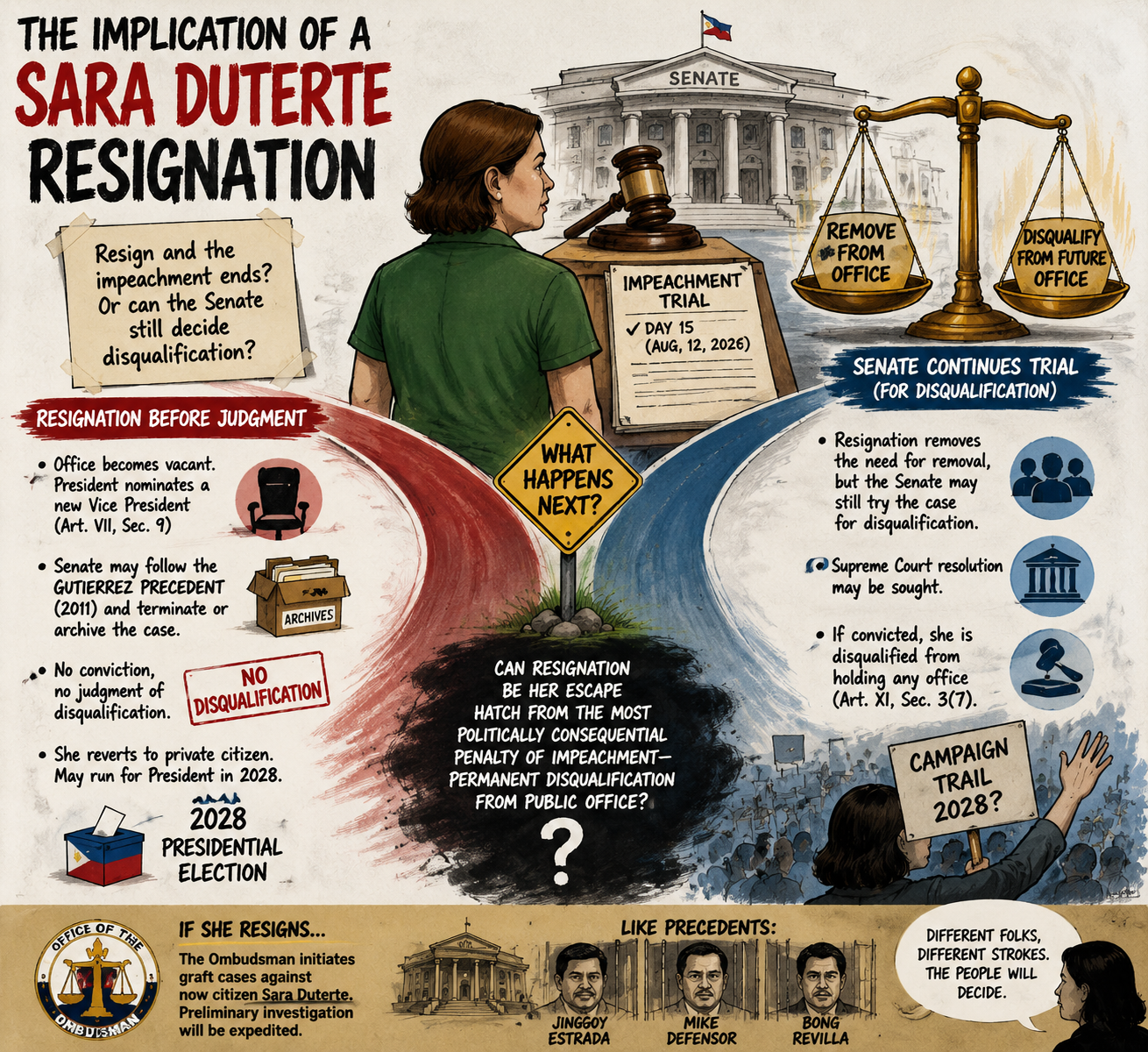
There is a significant historical precedent for considering the possible effect of Vice President Sara Duterte’s resignation on her pending impeachment trial.
Former Ombudsman Merceditas N. Gutierrez, an appointee of President Gloria Macapagal-Arroyo, assumed office on December 1, 2005. She remained Ombudsman after President Arroyo left office and Benigno S. Aquino III became President in 2010. Impeachment complaints were thereafter pursued against her in the House of Representatives. The House eventually voted overwhelmingly to impeach her, 212-46-4, and the case was transmitted for trial before the Senate.
Before the Senate could actually try and decide the charges, however, Gutierrez resigned, effective May 6, 2011. The Senate consequently sent the impeachment resolution to the archives instead of proceeding with the trial. Thus, Gutierrez was never convicted by the Senate and, correspondingly, no judgment of disqualification from future public office was entered against her.
That precedent is highly relevant to Sara Duterte, whose present impeachment trial is already underway before the Senate and had reached its fifteenth trial day by August 12, 2026. If Duterte were to resign as Vice President before judgment, her lawyers could invoke the Gutierrez precedent and argue that the principal constitutional object of impeachment—removal from office—has already become moot because there would no longer be an officeholder to remove.
But there is an important constitutional qualification. Article XI, Section 3(7) provides that an impeachment judgment may consist of removal from office and disqualification from holding any office under the Republic. The Constitution also gives the Senate the “sole power to try and decide all cases of impeachment.” Consequently, resignation would undoubtedly eliminate the necessity of removal, but whether it also constitutionally deprives the Senate of authority to continue the proceeding for the remaining purpose of determining disqualification is a separate question. A Supreme Court resolution might be sought by a party in interest. The Gutierrez episode establishes what the Senate did in 2011; it does not necessarily establish an immutable constitutional rule that every impeachment case must terminate upon resignation.
That distinction is crucial. If Sara Duterte resigns and the Senate follows the Gutierrez precedent by terminating or archiving the impeachment case without rendering a judgment of conviction and disqualification, there would be no impeachment-based constitutional disqualification preventing her from running for President in 2028. Article XI attaches disqualification to a judgment in an impeachment case; resignation by itself is not such a judgment.
She would then revert to the status of a private citizen, subject, of course, to whatever criminal, civil, administrative, electoral, or other proceedings may independently be legally available. The Constitution itself expressly provides that an impeached and convicted official may still be prosecuted and punished under ordinary law, demonstrating that impeachment and ordinary legal liability are conceptually separate.
There would also be an immediate institutional consequence: resignation would create a vacancy in the vice presidency. Under Article VII, Section 9, the President would nominate a new Vice President from among the members of the Senate or House, subject to confirmation by a majority of each House voting separately.
Conclusion:
Resignation could be Sara Duterte’s constitutional escape hatch from the most politically consequential penalty of impeachment—permanent disqualification from public office—but only if the Senate treats her resignation as terminating the impeachment case, as it did in the case of Merceditas Gutierrez. If the case terminates without conviction and without a judgment of disqualification, her resignation as Vice President would not, by itself, prevent her from seeking the presidency in 2028. The unresolved question is whether today’s Senate would be constitutionally compelled to stop, or could instead continue the trial for the purpose of deciding disqualification. If she resigns, the Office of the Ombudsman now initiates graft cases against the now citizen Sara Duterte. The preliminary investigation will of course be expedited like what happened to Senators Jinggoy Marcoleta and former Kongresman Mike Defensor. Remember the Ombudsman is the author of the standard “certainty of conviction” versus prima facie or probable cause protocol. She gets incarcerated and goes with the way of Bong Revilla asking for bail claiming her cases are all manufactured and short of probable cause.
Right now, if you notice, she’s already on the campaign trail for the presidency, in another path via a well publicized impeach process that made her fans glued to social media, like what Diosdado Macapagal did when he was Vice President of Carlos P Garcia. Macapagal won the presidency in 1962. Will Sara duplicate in 2028 as presidential bet what Cong Dadong chalked up in 1962?
Different folks different strokes.