

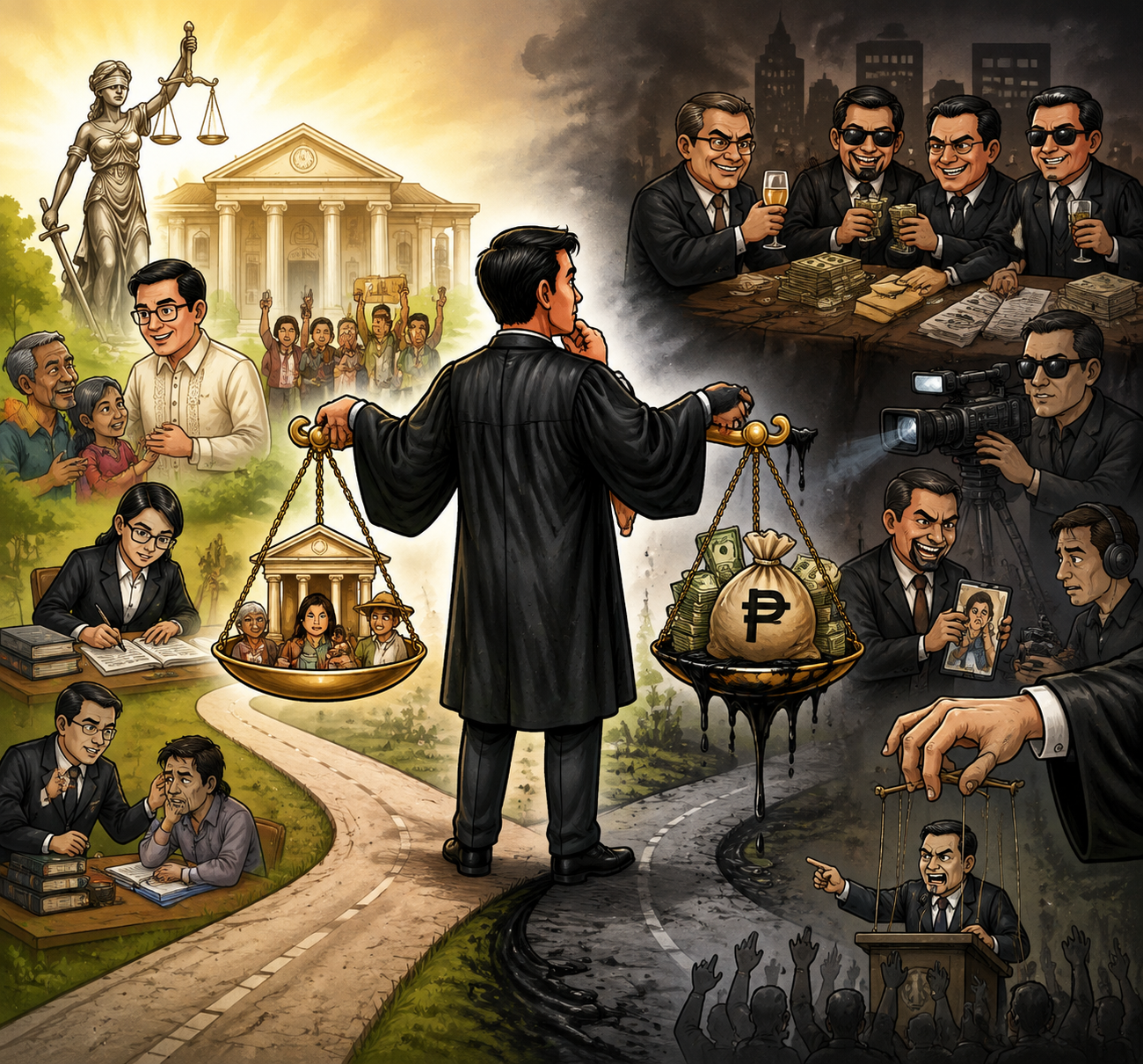
The involvement of lawyers in criminal schemes raises a broader and uncomfortable question about the legal profession in the Philippines: have we reached a point where there is an oversupply of lawyers competing for a limited market for legal services? What happened to Atty. Levito Baligod and the four lawyers identified with Atty. Ruy Rondain? There was a time when ACCRA lawyers were accused of hiding behind the mantle of lawyer-client confidentiality when they created fictional corporations to hide the fraudulent wealth of Ferdinand Marcos Sr.[TEODORO R. REGALA, EDGARDO J. ANGARA, AVELINO V. CRUZ, JOSE C. CONCEPCION, ROGELIO A. VINLUAN, VICTOR P. LAZATIN and EDUARDO U. ESCUETA vs. THE HONORABLE SANDIGANBAYAN, First Division, REPUBLIC OF THE PHILIPPINES, ACTING THROUGH THE PRESIDENTIAL COMMISSION ON GOOD GOVERNMENT, and RAUL S. ROCO https://lawphil.net/…/juri1996/sep1996/gr_105938_1996.html]
Law is traditionally described as a noble profession, and in principle it should remain so. But in practical economic terms, the practice of law also operates under the realities of business. A lawyer must maintain an office, hire and pay staff, purchase equipment and supplies, pay transportation and gasoline expenses, travel to courts, starch their barongs to be presentable, spend hours preparing pleadings and contracts, and shoulder the numerous expenses necessary to represent clients properly. Professional ideals do not eliminate overhead.
Consequently, the practice of law is also affected by the elementary economic principle of supply and demand. As more lawyers enter the profession, they necessarily compete for clients. This raises a legitimate policy question as to whether the continuing increase in the number of licensed practitioners has economic consequences that deserve greater attention from the institutions regulating admission to the Bar and the practice of law.
The problem is compounded by the ethical restrictions imposed upon lawyers in soliciting legal business. Unlike ordinary commercial enterprises, lawyers cannot simply advertise their services in the manner of merchants selling products. They must build their professional reputation within the boundaries established by legal ethics.
As a result, lawyers traditionally develop their practices in other ways.
Some enter public service or politics and, in the process, become known to constituents who approach them regarding legal problems. I experienced this personally when I ran for and served as a member of the Sangguniang Panlalawigan of Quezon. Holding public office naturally placed me in contact with people who needed legal guidance.
Others establish public-interest practices, taking up anti-corruption, environmental, human-rights, consumer, or other advocacy cases. Such cases frequently attract media attention, which consequently gives the lawyer greater public visibility.
Still others become known through successful cases, sometimes when satisfied clients themselves discuss or post about the results of their litigation.
Today, another avenue is social media. Lawyers maintain blogs, vlogs, podcasts, and online programs in which they discuss legal controversies, impeachment proceedings, political developments, court decisions, and virtually every important issue of the day. Some provide serious legal analysis; others appear primarily interested in visibility. Whatever the motivation, this phenomenon illustrates the intense competition for public attention within an increasingly crowded profession.
There is nothing inherently wrong with lawyers making themselves known through legitimate professional work. The danger begins when the competition for clients, money, political influence, or publicity tempts members of the Bar to cross ethical—and eventually criminal—boundaries.
Ambulance chasing, improper solicitation, fabrication of controversies, manipulation of witnesses, manufactured scandals, black propaganda, entrapment, invasion of privacy, and similar conduct are fundamentally incompatible with the duties of a lawyer.
Recent allegations concerning supposed schemes to compromise or embarrass public officials illustrate the seriousness of the problem. Where lawyers are alleged to have participated in creating compromising situations, secretly recording individuals, or manufacturing scandals for political purposes, those allegations must of course be established by competent evidence and due process. They should never be treated as proven merely because they circulate in politics or social media.
The same caution applies when referring to past controversies involving personalities such as Jim Paredes. The existence or circulation of private material does not, by itself, establish who obtained it, how it was obtained, or whether any government agency or lawyer was responsible for its disclosure.
But the underlying principle remains important.
A lawyer must never design a criminal enterprise merely because somebody is willing to pay for it. He cannot become the architect of an entrapment, a fabricated scandal, an illegal surveillance operation, or a scheme intended to destroy another person’s reputation. A lawyer is trained to understand precisely where legality ends and criminality begins. That knowledge makes deliberate participation in unlawful conduct even more reprehensible.
The oversupply of lawyers may create economic pressure. Young practitioners may struggle to obtain clients. Established lawyers may face intense competition. Offices must survive, employees must be paid, and families must be supported. These economic realities should not be ignored.
But economic hardship cannot become a defense for professional corruption.
Perhaps, therefore, the real issue is larger than simply whether the Philippines has too many lawyers. The question is whether the institutions governing the profession have adequately confronted the economic environment in which lawyers are expected to practice while simultaneously demanding the highest standards of professional conduct.
Producing more lawyers expands access to legal services and may serve important public purposes. But increasing their number without considering employment opportunities, geographic distribution, professional economics, ethical formation, and meaningful disciplinary enforcement may create unintended consequences.
The solution is not to condemn lawyers merely because there are many of them. Neither can criminal behavior automatically be attributed to competition within the profession. Criminality remains an individual choice.
Nevertheless, when lawyers begin acting as political operators, fixers, propagandists, or architects of illegal schemes rather than officers of the court, the legal profession has reason to examine itself.
A lawyer may need clients to survive.
But the moment he manufactures a crime in order to obtain a client, satisfy a client, or enrich himself, he has ceased to behave as a lawyer worthy of the profession.