

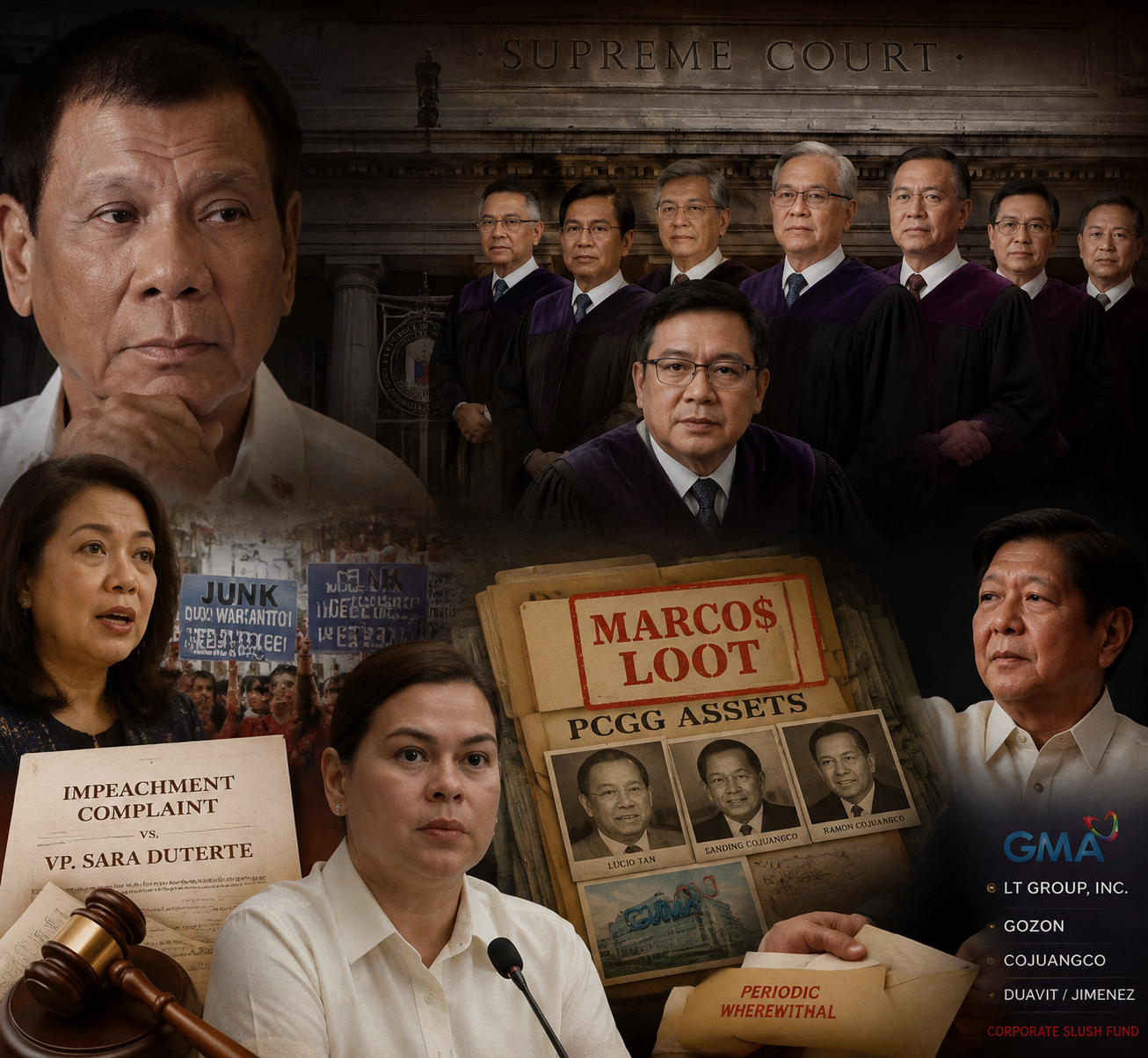
Another significant aspect of Rodrigo Duterte’s legacy concerns the judiciary, particularly the appointments he made to the Supreme Court and the lower courts during his presidency.
When Duterte assumed office in 2016, he was in the unique position of appointing an unprecedented number of members of the judiciary. During his term, Chief Justice Maria Lourdes Sereno was removed from office through a quo warranto proceeding. Her vociferous objections on treating judges suspected as coddlers of drug lords and particularly on issues involving human rights and the government’s campaign against illegal drugs. “Napasobra ang yabang ni Alou Sereno sa mga patama nya kay Digong,” remarked by a former President of UP in one occasion in 2019. He added, “eh ngaun lang nangyari na walang martial law declaration, eh kamay na bakal ang palakad ni pogi!”
By the time Duterte left office in 2022, he had appointed a majority of the sitting members of the Supreme Court, including Chief Justice Alexander Gesmundo. As a result, the Court as an institution significantly shaped by his appointments. During Gesmundo’s interview before the Judicial and Bar Council, he was asked what was his position in the president’s martial law declaration in Mindanao, his answer was, “the president knows more than we do. It’s legal.” This answer sent paroxysm to Duterte’s gang in Malacañang headed by Executive Secretary Salvador Medaldia. That clinched his appointment to the High Court.
There have also been persistent anecdotal accounts alleging that lawyers representing Vice President Sara Duterte were encouraged to file multiple petitions before the Supreme Court involving a variety of legal issues. The strategy was to inundate the Court with cases so that, in demonstrating its institutional independence, it would dismiss most of the petitions while granting relief in a select few involving issues of greater constitutional or political significance favorable to Sara.
One of the Court’s most consequential rulings involving Sara Duterte was its decision invalidating the first impeachment complaint against her on due process grounds. The ruling went beyond merely resolving the controversy and effectively prescribed procedural standards that Congress should observe in future impeachment proceedings.
Another subject of continuing political debate concerns the disposition of assets sequestered after the 1986 EDSA Revolution. Following the revolution, the Presidential Commission on Good Government (PCGG) was created to recover assets alleged to have been unlawfully acquired by the Marcos family and their associates. Over the years, the Commission recovered substantial properties and funds, although disputes over other assets have persisted. The PCGG more or less succeeded. However, there are some crown jewels of the Marcos loot that were in the hands of Lucio Tan, Danding Cojuangco, and Ramon Cojuangco, and the GMA Channel 7, previously owned by Bob Stewart, and ostensibly acquired by the Duavit and Jimenez families. Upon the ascension of Marcos as President in 2022, a clear message was conveyed to these trustees of the Marcos properties. Instead of rocking the boat for the first two years, these trustees, like Lucio Tan, Attorney Felipe Gozon, Ramon Cojuangco estate, and Danding Cojuangco estate cough up BBM’s periodic wherewithal.
Certain corporate interests and business groups historically associated with individuals linked to the Marcos era maintained informal financial accommodations with the administration after Ferdinand Marcos Jr. assumed the presidency in 2022. A lawyer once connected to a GMA 7 bigwig disclosed that periodic financial support is channeled to the sitting president and the use of corporate accounting mechanisms, such as depreciation cost, reserves or other cash-flow sources as the origin of the slush fund.