

The Department of Agrarian Reform (DAR) has reaffirmed its commitment to stand with Agrarian Reform Beneficiaries (ARBs) affected by the final ruling of the Supreme Court of the Philippines involving the Gala landholdings in Sariaya, Quezon.
DAR Secretary Conrado M. Estrella III said the Department recognizes that the Supreme Court’s Resolution has attained finality and immutability, meaning it is final, executory, and can no longer be reversed by DAR or any other executive authority.
The case covers a total of 522 hectares of agricultural land located in Barangays Concepcion 1, Concepcion Pinagbakuran, Manggalang Kiling, and Sampaloc II in Sariaya, Quezon. Of this area, 328.8277 hectares were distributed to 266 ARBs between 1989 and 1992 under the Comprehensive Agrarian Reform Program (CARP).
However, the landowners filed for exemption, arguing that the properties had already been classified as non-agricultural as early as 1982 through a municipal zoning ordinance.
After decades of legal proceedings—including reviews by DAR, appeals to the Office of the President, and rulings by the Court of Appeals and the Supreme Court—the High Court ruled to exempt the entire 461.2102 hectares from CARP coverage. The Resolution became final and executory on September 23, 2020, resulting in the cancellation of several land titles previously issued to ARBs.
Secretary Estrella emphasized that once a judgment becomes final, it must be respected to preserve fairness and stability in the justice system.
“The principle of immutability of judgment ensures that legal disputes reach a definite conclusion. While there are very limited exceptions under the law, these can only be determined and acted upon by the Supreme Court itself,” Estrella said.
Despite the legal finality of the case, Estrella expressed deep concern for the affected farmers.
“We understand the pain and uncertainty our farmers are experiencing. Many of them have devoted their lives to cultivating these lands. While we are bound to follow the law, we assure them that DAR will not abandon them,” he added.
In June 2021, the Presidential Agrarian Reform Council Executive Committee (PARC ExCom), through PARC ExCom Resolution No. 2021-148-04, created the Inter-Agency Task Force Sariaya to conduct an in-depth study of the subject landholdings and recommend appropriate actions.
The Task Force is composed of representatives from DAR, the Department of Agriculture, National Irrigation Administration, Local Government Unit of Sariaya, Commission on Human Rights, KATARUNGAN, and UGNAYAN-SAR.
As part of its mandate, the Task Force conducted field validation and consultations with concerned ARBs to assess their on-ground situation and formulate recommendations. These efforts aim to guide PARC ExCom in determining suitable interventions and possible assistance, including legal support, mediation, and alternative livelihood opportunities.
“Our responsibility does not end with land distribution. Our farmers remain at the heart of our mission. We will continue to assist them and help them move forward with dignity and hope,” Estrella said.
𝗣𝗿𝗼𝘁𝗲𝘀𝘁𝗲𝗿𝘀 𝗽𝗿𝗲𝘀𝘀 𝗳𝗼𝗿 𝗦𝘂𝗽𝗿𝗲𝗺𝗲 𝗖𝗼𝘂𝗿𝘁 𝗿𝗲𝘃𝗶𝗲𝘄
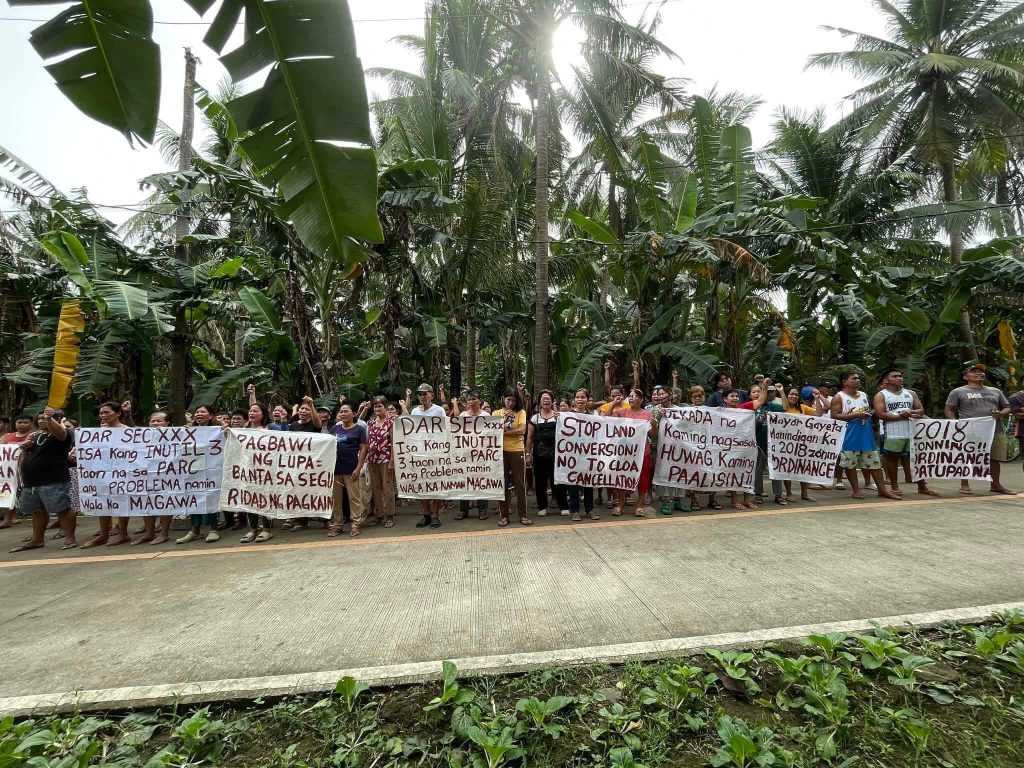
Hence, hundreds of farmers, fisherfolk and youth held a protest on Feb. 15 in Barangay Manggalang Kiling, urging President Ferdinand “Bongbong” Marcos Jr., Estrella and Sariaya Mayor Marivic T. Gayeta to act on their appeal following the cancellation of their Certificates of Land Ownership Award (CLOAs).
Protesters called for the reopening of the CLOA cancellation issue before the Supreme Court and urged the local government to enforce the municipality’s 2018 zoning ordinance, which they said would help protect their agricultural land and community.
The farmers said PARC has conducted field validations and meetings to identify legal measures that would safeguard their rights to food, livelihood, housing and the environment, but claimed no clear resolution has been issued on their grievance.
On Feb. 3, 2026, the Sariaya Sangguniang Bayan passed a resolution supporting the farmers’ cause and recognizing their role in local food supply and economic development, the groups said.